

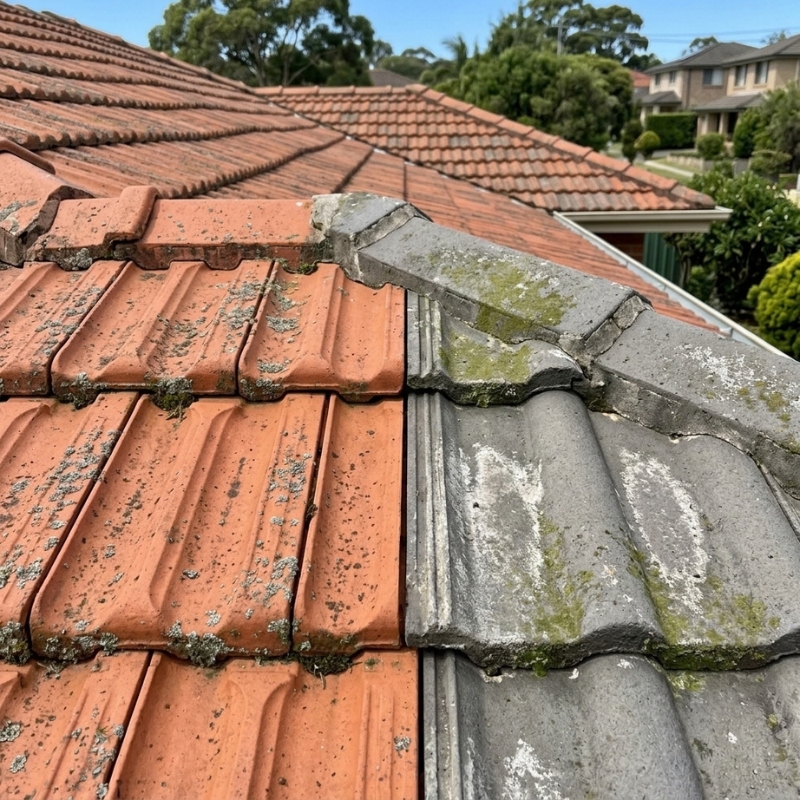
Walk down your street after a wet stretch, and you will often see the same thing: one tiled roof streaked green and black, the one next door barely marked, both roughly the same age. The difference is usually not luck or neglect; it is the material. Terracotta and concrete tiles stain in fundamentally different ways, for reasons built into what each one is made of, and that difference decides how each should be cleaned. This article explains how to tell which tiles you have, why terracotta stains from within while concrete stains on the surface, why the same clean does not suit both, and the honest limits of what cleaning can fix.
Unsealed terracotta is porous, so it holds moisture and stains from within, which is why lichen bonds to it so firmly. Concrete tiles stain mostly on the surface as their factory coating wears, which is why they go green and chalky. The materials need different treatment.
How to Tell Which Tiles You Have
Before anything else, it helps to work out which material is on your roof, and there are a few tests you can do from the ground or a window.
Colour through the body against colour on the surface. This is the most reliable tell, and it needs a broken or chipped tile to see. On terracotta, the colour runs right through the body of the tile, because it is fired clay all the way through, so a broken edge is the same colour inside as out. On concrete, the colour is a coating on the surface, so a broken edge reveals plain grey concrete underneath. If you can find a cracked tile, that edge settles it.
The ring when tapped. Terracotta tends to give a higher, more ceramic ring when gently tapped, while concrete sounds duller and more solid.
The profile shape. Terracotta is often seen in the older Marseille and scalloped profiles, where concrete commonly comes in flatter, more modern shapes.
The age of the house. This is a useful guide in Sydney. Terracotta is common on older, pre-war homes, while concrete became widespread on later builds, so the era of the house narrows it down.
A broken tile edge beats all the other tests, so if you can safely spot one, start there.
Why Terracotta Stains From Within
The key thing about unsealed terracotta is that it is porous, and that single property explains most of how it stains. The fired clay is full of tiny pores, so the tile absorbs and holds moisture rather than shedding it all off the surface. That retained moisture is exactly the damp environment that biological growth thrives in, which is why terracotta attracts lichen and moss so readily.
More than that, lichen does not simply sit on top of a porous terracotta tile; it roots into the surface. The organism works its way into the open pores and bonds firmly to the tile, which is why lichen on terracotta is so stubborn and why a light wash tends to leave the roots behind to bloom again. The staining comes from within the surface rather than resting on it.
A few patterns follow from this. The southern and shaded elevations go first, because they stay damp longest and dry out slowest, giving growth the moisture it needs. Coastal salt air accelerates it, since the salt-laden air keeps surfaces damp and encourages the breakdown of the tile surface. And importantly, aggressive cleaning can make the next bloom faster, because blasting a porous terracotta tile too hard opens the surface up further, creating more texture and pore space for moisture and growth to take hold, so a harsh clean can leave the roof worse off down the track.
Terracotta staining typically looks like:
- Lichen in crusty, grey-green or orange patches bonded tightly to the tile.
- Dark moss building up in the pores and along the laps.
- Staining is worst on the shaded and southern faces of the roof.
Because the staining is on the surface rather than in it, the right approach matters, which is what proper terracotta roof tile cleaning is built around.
Why Concrete Stains on the Surface
Concrete tiles tell a different story, because their colour comes from a factory-applied coating rather than running through the tile. That coating is what gives a concrete tile its colour and its initial surface protection, and the way it ages is the key to how concrete stains.
The coating wears rather than fades evenly. Over years of UV and rain, it thins and breaks down, and it does so unevenly across the roof, so you get a patchy, tired appearance rather than a uniform softening of colour. Once that coating has worn away, the exposed cement underneath goes chalky, developing that powdery, dull grey surface, and bare cement holds algae readily, which is why a worn concrete roof goes green.
The thing to understand is that concrete often looks worse faster but is less deeply bonded. A concrete roof that has lost its coating can look quite dramatic, green and chalky and blotchy, but much of that staining is sitting on the surface rather than rooted deep into the body the way lichen bonds into terracotta. So it can look alarming while being, in some respects, more straightforward to clean off the surface.
Concrete staining typically looks like:
- A chalky, powdery grey surface where the coating has worn through.
- Green algae spreading across the exposed cement.
- An uneven, patchy appearance rather than uniform fading.
Why the Same Clean Does Not Suit Both
Here is where people go wrong: they treat a tile roof as a tile roof and use one method on everything. A cleaning approach that is perfectly fine on a sound concrete tile can open up a porous terracotta surface, driving moisture in and creating more texture for the next bloom of growth to grab onto. The pressure and method that clears surface algae off concrete can be exactly what degrades a terracotta tile. This is why identifying the material before choosing a cleaning method is the single most important step, and it is the step most often skipped. Matching the method to the material is what protects the roof rather than quietly setting up the next problem.
What Cleaning Can and Cannot Fix
It is worth being straight about what a clean actually achieves, because expectations here often do not match reality. Cleaning removes growth and surface staining. It lifts the moss, lichen and algae and clears the surface discolouration, and on a sound roof, that restores the appearance well.
What cleaning cannot do is restore a worn coating or reseal a porous surface. If a concrete roof has lost its factory coating, no amount of cleaning brings that coating back, and the chalky, unprotected cement will keep attracting algae. Similarly, cleaning a porous terracotta roof clears the growth but does not change the porosity that let it take hold. A roof in that condition needs recoating rather than repeat cleaning, because cleaning it over and over is treating the symptom while the cause, the lost or absent protective surface, remains.
So the real distinction is between a roof that is dirty and a roof that is worn. A dirty roof with its surface intact responds well to cleaning. A worn roof that has lost its protective coating needs restoring, which is where roof painting in Sydney comes in: recoating the tiles to protect them again rather than just washing a surface that no longer has any protection left. Knowing which of the two you have is what decides whether cleaning is the answer or only a temporary one.
Frequently Asked Questions
Can terracotta tiles be sealed after cleaning?
Terracotta can be coated or sealed after cleaning to reduce how readily it absorbs moisture, which helps slow the return of growth on a porous surface. Whether it suits your roof depends on the tile’s condition, so it is worth having the tiles assessed before deciding on sealing.
Why does the moss come back so quickly?
On terracotta especially, because the lichen and moss root into the porous surface, so a light clean removes what is visible but leaves the roots behind to regrow. Shaded, damp elevations also keep providing the moisture growth needs, so it returns fastest there.
Is the white powder on my tiles mould?
More often it is chalking, where a concrete tile’s coating has worn through, and the cement surface beneath has gone powdery, rather than mould. It is a sign the protective coating has broken down, which points to a roof that is worn rather than simply dirty.
Does staining mean the roof is leaking?
Not usually. Staining and leaking are different problems: staining is biological growth or a worn surface on the outside, while a leak is water getting through to the inside. If you are worried about water entry, roof leak detection in Sydney is the way to check that separately.
Knowing your roof before you treat it
The short of it is that terracotta stains from within because it is porous, while concrete stains on the surface as its coating wears, and that is why the two need different treatment. Work out which you have, ideally from a broken tile edge, and you are halfway to knowing what your roof actually needs. Most Sydney tile roofs benefit from a clean every 2 to 3 years, though a worn roof needs more than that. If you are not sure which tiles you have or whether yours needs cleaning or recoating, we can identify the material and the condition and tell you which one it is.